
An interior is the natural projection of the soul. —Coco Chanel
Design is an intrinsically conscious process, the deliberate act of forming materials to fit a certain utilitarian or aesthetic function.
Please visit my YouTube Channel, Kimberly B. Gray, Good Design is the Art of Living! Here’s the link:
ST. FRANCIS CATHEDRAL BASILICA, PART II, INTERIOR DESIGN & DECORATION
Welcome back to Kimberly B. Gray for Part II of the St. Francis Cathedral Basilica and its Interior Design and Decoration.
Before entering the Cathedral Basilica, the bronze statue of St. Francis of Assisi is found. St. Francis is the patron saint to whom the Cathedral is dedicated. Two forms of wildlife are portrayed—the wolf and the birds—because of stories of old regarding St. Francis.
A second bronze is of the first archbishop, Jean Baptist Lamy. One of five archbishops from France, he served from 1850-1885. He is buried in the crypt under the Cathedral Sanctuary.
Also gracing the courtyard is a third bronze sculpture, polychromatic in design, of the first Native American saint and was created by Jemez Pueblo artist, Estella Loretto.
The 20-paneled bronze doors are a bit reminiscent of Ghiberti’s famous bronze doors in Florence. Created by Santa Fe artist Donna Quasthoff, the history is recounted of the church in Santa Fe.
The Romanesque characteristics of the exterior and interiors is represented by the arches and by the stonework in the Roman Byzantine style. A delineated facade of contrasting red and yellow sandstone includes a central Romanesque portal with a demilune stained glass window, rose window, and dentil pediment; two towers, with Romanesque arches and corner pilasters rise two stories. The capitals on the exterior are impost in design; unlike the ornate interior capitals, the impost carved capitals on the exterior are stone.
The strength of the Romanesque Gothic architecture is supported by way of the buttresses flanking the exterior of the nave side aisles. The architecture of the Cathedral is also referred to as basilica architecture. In Early Christian and later in Romanesque architecture, it was more often a building with a high, wide, central nave flanked by two or more lower, narrower side aisles. The Roman Catholic Church makes its own distinction about which buildings deserve the name Basilica (with a capital B) because “of their antiquity, dignity, or historical importance as centers of worship.” Therefore, St. Francis Cathedral is both a Basilica and is architecturally basilica-style!
Moved from above: Upon entering the narthex of the Cathedral, a small Chapel of St. Anthony of Padua is located; the stairs access the balcony over the narthex containing the pipes of the organ and also access to one of the two bell towers.
Resume Here via Video: The nave of the Cathedral with side aisles features some of the interior Gothic architectural elements of groin vaulting and clerestory windows above the Composite Order columns of polychromatic acanthus and volute relief on the capitals. The nave and side aisles with groin vaults are set on transverse arches, and all around windows, arches, and horizontal railings below the windows are decorated with polychromatic stenciling, which was extensively added throughout the nave and restored over time. The acrylic paint applied in the late 20th Century added deeper reds and oranges to the mix of metallic gold, mauve rose, ochre, hints of sky blue and muted blue; all provides a contrast to the sage green ground.
The polychromatic stenciling is replete with Gothic patterns of stylized rosettes and quatrefoils, which seem to reference the gardens and parterres in France. And some stenciling pattern seems to echo designs found in Native American rugs. Other designs apparent in the stenciling is the rinceau, arabesque, and anthemion, which are plantlike ornament. Also found are heraldic-like shield designs inside rondels and grill motif.
Most of the religious decorative arts are Spanish in derivation. The interior Stations of the Cross, all 15, which mark the passion, death and resurrection of Jesus Christ, are designed in what is known as retablo style by Santa Fe Santera Marie Romero Cash. The framing was carved by Roberto Montoya. All Stations surround the side aisles of the nave and intersperse the stained glass windows.
The Stained Glass Windows were installed in 1884 and were commissioned by Archbishop Lamy by the Atelier Felix Gaudin in his native France. The windows achieve several purposes: Light, considered the most important element of design; decoration; instruction by depicting saints and scenes from the Scripture; and a sense of poetry that no clear glass could produce.
The translucent nature of stained glass cuts off the exterior view and has been described as the spiritual unity of the inner space wherein the luminous curtain protects the interiors from the profane outside world; the church must not appear as if illuminated from without, but as if walls were fashioned out of self-luminous precious stones. Around the space of the Gothic Cathedral, Heaven descends like a mantle of crystalline light. —Titus Burckhardt.
The clerestory windows are located above the side aisles at the top portion of the nave.
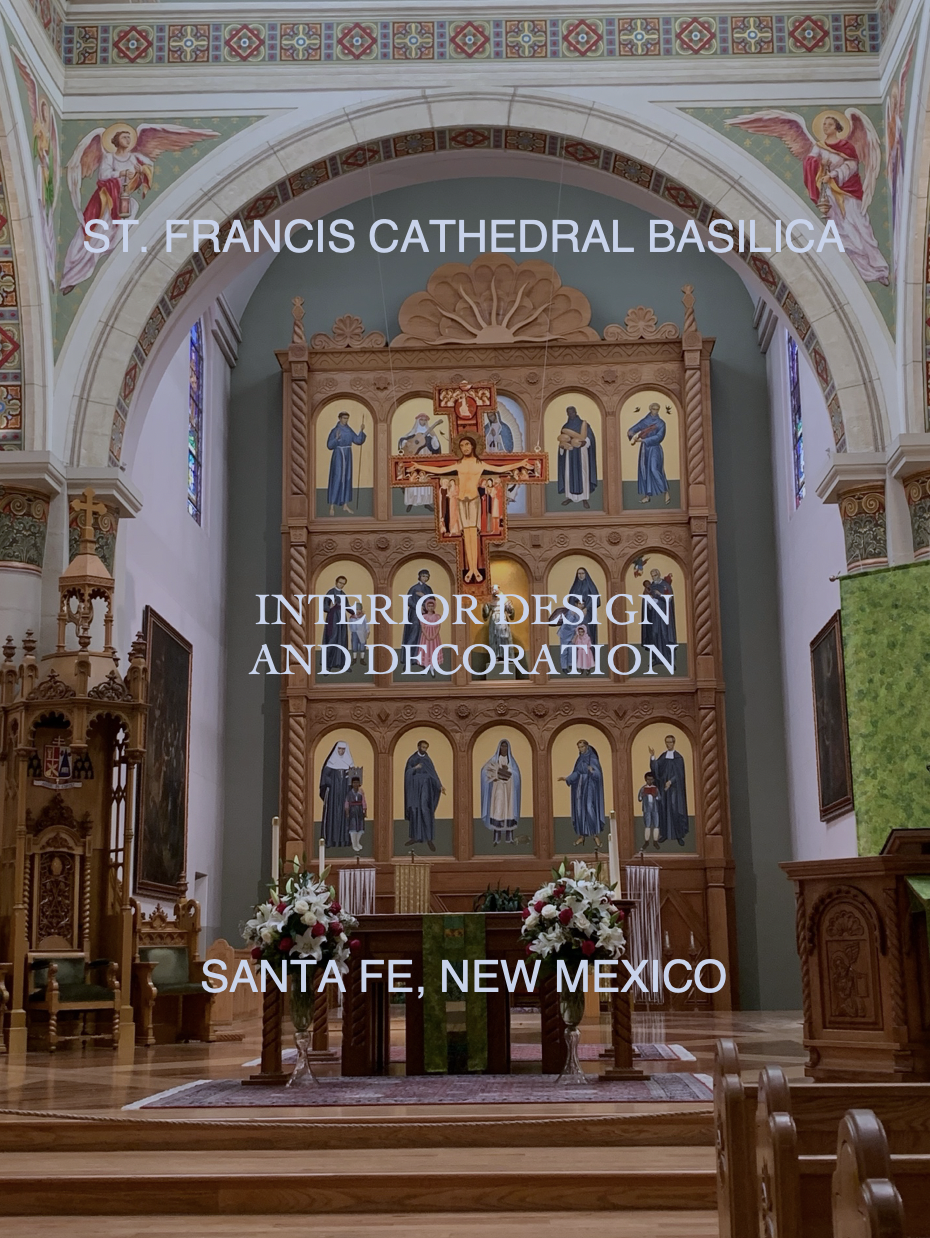
At the altar, above the sanctuary, is a replica of the crucifix of the one through which Christ spoke to St. Francis, The San Damiano Crucifix.
The Sanctuary area is also known as the Apse; it was enlarged for the 100th Anniversary of the Cathedral in 1986. It is here that the liturgies including Mass are celebrated. On the left is the Archbishop’s Chair, which is also indicative of the status assigned to the Cathedral as the seat of a bishop and the administrative center for the bishop’s diocese or territorial jurisdiction. The status of Cathedral is derived from the fact that the building traditionally holds the bishop’s cathedra or official throne. The throne is carved in the Gothic style. Symbols of the elevation of the Cathedral to the rank of Basilica by Pope Benedict XVI in 2005 are represented by the Tintinnabulum, or brass pole, with a brass circle and bells, as well as the Umbrellino, a small red and gold umbrella.
The Reredos, or Altar Screen, was also created in 1986 for the 100th Anniversary and holds a 17th Century statue of St. Francis and the images of Our Lady of Guadalupe and other saints of the Americas. The screen was carved by Taos woodcarvers Robert Lavadie and Paul Martinez and painted by Brother Robert Lentz. A frequent carved design found in the Reredos and Retablos of the Stations of the Cross is the Solomonic spiral, as well as the shell design, sometimes concave and sometimes convex.
The Romanesque and Gothic footprint common to Cathedrals is the cross transept wherein the nave faces eastward toward the Altar and the transepts extend from the Altar South and North. The South transept was once the Chapel of San Jose, which was deconstructed in the 1960s and a new arm was built.
The North transept, La Conquistadora Chapel (Our Lady of Peace), is the oldest arm of the Cathedral and part of the 1714 church on this site; the vigas and latillas and the corbels and posts are all original and hand hewn. The statue of Our Lady arrived in Santa Fe in 1625 and is the oldest Madonna in the U.S.; she stands about 3 feet in height. Beneath her is a 19th Century bultos of Christ the Nazarene. A key is located on the wall naming the other saints on the 18th Century Reredos Altar Screen.
The large painting of the Temptation of Christ was rendered by Pasqual Perez in 1710, along with two other paintings in the Sanctuary, were all a gift to the older parish. The reliquary case holds the relics of many saints. A small ossuary, containing the remains of two early Franciscan missionary priests, is encased to the right of the reliquary case.
The most profound of interior design elements in this beautiful and spiritual space are Light and Color. Often is said in design that Light is Color and Color is Light. Light is the Spiritual nature of the Universe. Some philosophers and esoteric writings seem to regard that Christ Consciousness exceeds the limits of the Speed of Light and exceeds the Physics recorded in this ‘profane world’ of the 3D, our existing Third Dimension.
Thank you to two of the docents at St. Francis, Ernie and Laurie, in providing additional information to my research of the St. Francis Cathedral Basilica in Santa Fe, New Mexico. My personal research of the interior design and decoration stems from my studies in Art History and in teaching History of Interiors.
–Kimberly B. Gray, Santa Fe, New Mexico. All Rights Reserved.

 Kimberly B. Gray