
Balance; Rhythm: Repetition, Progression, Transition, Contrast; Emphasis; Scale + Proportion; Harmony: Unity . . . These are the composite features of Design Principles.
Of the many doorways we pass in a short walk, most are fulfilling their purpose, most of them are well-enough built. How many are worth a second look? It seems that there is something more than merely “function,” something more than good construction, something more difficult to achieve, if so few can achieve it. It is precisely the pursuit of this something that makes of architecture a thing apart . . .
—Paul Phillipe Cret, Architect, 1876-1945
In my upcoming Memoir about the past 11 years, my contemplations of life seem to go often to the Principles learned in design, and hence, life, and even destiny.
I once told my design students on many occasions, The Secret to the Universe is found in the study of design. The more I thought about this, the more I discovered Truth for myself.
I now know that we learn and acknowledge by walking through more doors than just passing doorways. True, the entering can be painful and challenging. But, we can never know the Beauty and Order of a concept without the action and the application of the Principles we employ to live our lives. And, the most important lesson that my Dad taught me is the value of a moral compass. To be sure, a moral compass relates to Design Judgment; even so, without such, the praxis of Principles will lose a directional application to Design Elements. Let me provide an example.
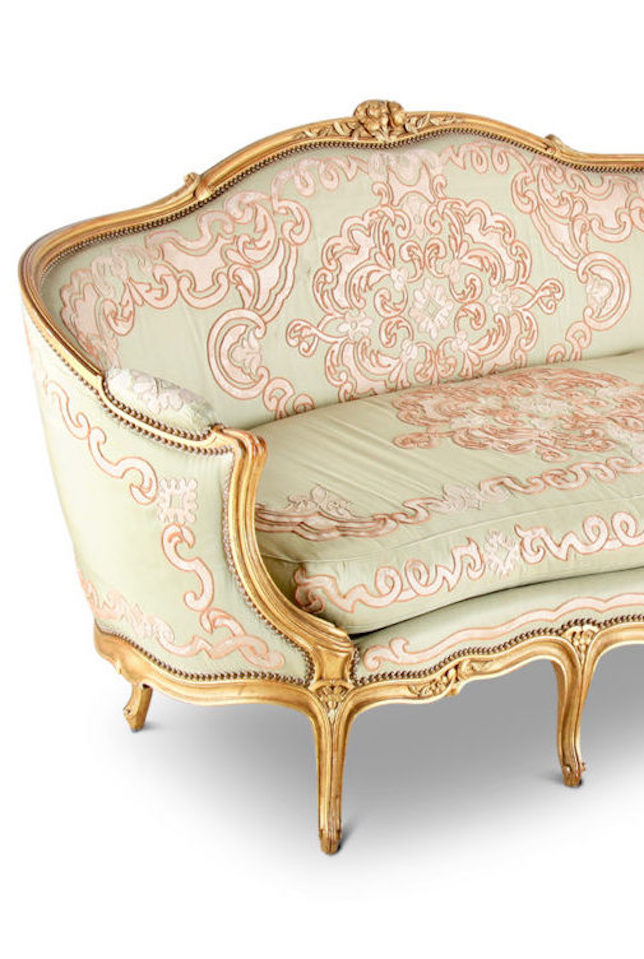
Take the Design Element of Form. Form in design is an element that you can wrap your arms around. Imagine a sofa in the style of Louis XV. You have loved that sofa forever. It has its original silk damask covering in a desert Southwest sage colorway. The bench seat cushion is down-filled. The seat back is tufted. The interior is 8-way hand-tied artistry. The painted and patinated wooden cabriole legs, and S-curve and C-curve trim is hand-carved. Most of all, you love the story behind how you came to claim the art form as your own; the acquisition backstory carries notes of Italy and roses.
And now, you are restoring and renovating the interior space of a 1970s Ranch-style home with straight lines and vaulted ceilings.
Where to begin?
Design is developmental. Design takes time. Not all situations or even individuals adapt to change, especially when morality and Truth are challenged. This is where neuroplasticity comes in, as it results from learning and experience. A Spiritual component is inherent in this part of our humanity: The ability to adapt to changing inputs and changing conceptual structures is what the Universe really is. Therefore, when Principles are applied to the Elements in varying ways, the dwelling evolves to a higher level of Being. That is the something that makes architecture or someone’s life a thing apart.
If we, in a most basic way, focus only on function, we will sacrifice Beauty and Order. Function is merely at a level of the 3D, the materium, if you will. Higher levels of design contain the results of Beauty and Order, a marrying of Principles with the Elements of Design, so very Spiritual. With such focus on the Spiritual, the moral compass will steer you to destiny, the place of your Belonging.
That beautiful sofa first found its way into an early 20th Century Dutch Colonial Revival dwelling. Quite appropriate considering that cabriole legs are most historically connected to a Dutch furniture designer and carver, Daniel Marot (1661-1752), who first actualized his art during the late Baroque period of the 18th Century in the form of William and Mary, known for turned legs on furniture pieces.
After Marot introduced the Dutch club foot to the cabriole leg, the French elevated the form to heights of frivolity that came to be Louis XV furnishings, asymmetrical, ornate and exuberant, in the fashion called rocaille. The Design Judgment of some can result in a hypercritical nature of this exuberance; that’s what happens in the 3D of design. Arrogance comes to supersede Beauty. Beauty is sacrificed on the altar of small mindedness. The real crux of Good Design is that it has not a whit to do with being judgmental!
Thank you, Daniel Marot, for the simplicity of your original cabriole leg and foot, and thank you to the French during the time of Louis XV for your exuberance. A unique quality of our humanity is the emotion that actualizes Beauty beyond utility. Certainly Beauty is a quality or combination of qualities that gives pleasure to the mind or senses; however, when Beauty is associated with Harmony and Proportion—both Principles—of Form or Color and even Space—all three Elements—then authenticity and originality are achieved.
Form does not stand solitary either, nor does any single Design Element, whether it be Light, Color, Space, Form/Shape, Area/Plane, Line Texture, or Ornament/Pattern; nor does any Design Principle. Each is Sovereign in its Beauty, yet all work in tandem toward Harmony and Unity of the whole. The Principle of Contrast is best representative of my sofa example (Form) with the renovation (Space).
Simply because the Louis-style sofa is so loved and because the same love is being bestowed upon a Ranch-style renovation, destiny is sealed. The action of Principle with Element is a shared common destiny. By looking to make good decisions and examining actions through the totality of circumstances and synchronicity, as broad as the mind can conceive, then a greater grasp can be had of consequence of behavior. This way of living offers a great level of promise and great level of ethical return for approaching these applications in this way.
I wish that we all could live life this way.
And so, to integrate a sofa (Form) in the style of Louis XV, one may not typically find such an element in a Ranch-style home (Space). It is important that the Principles of Design be engaged.
One point of engagement is marrying the Principle of Contrast with the Elements of Form and Space. To Contrast Form and Space in design is to demonstrate not just Beauty but also to reveal the Truth of our personal Principles. This is individual.
I refuse to accept the deception of corruption being projected upon America and the world at the expense of my moral compass and Truth. My regard for Principle supersedes the Evil from subjecting my Truth to compromise and compliance because I am a Sovereign person. The Body Temple that the Creator endowed me will not allow it.
If this Principle of Contrast in this world of Form and Space is not based in Beauty and Order and most importantly Love, then as a designer, I am unable to believe this America attempting to steal my Sovereignty will control me. I know better. I will create my life for me.
The Truth of my experiences taught me to know what is best for me. Not just believe, because circumstances can lead one to wrong conclusions and choices. And, risk the ultimate—loss of life or loss of the quality of life.
The first time I studied the Principles of Design, I was filled with a Spiritual knowing of the musical quality of the Principles. Regarding Contrast in music and musical form, Contrast is the difference between parts or difference in musical sounds. Further, in music three types of Contrast may co-exist: rhythmic, melodic, and harmonic. And then, Contrast may be procedural—stratification, juxtaposition, and interpolation. Here’s the Beauty and Order of Contrast . . . it may also lead to procedures of connection: gradation, amalgamation, and dissolution.
Principles are not only about one’s moral compass and integrity; Principles are Spiritual.
Never sacrifice Principle on the altar of small-mindedness. Seek Truth, no matter how far you must go to find it. And God knows I’ve taken a Path of Contrast. However, it made all the difference, because I ultimately connected with Spirit.
Happy New Year Everyone. May 2022 be your Year of Truth and Spirit.
—Kimberly B. Gray, Santa Fe, New Mexico

 Kimberly B. Gray